The above information is referenced by many Naturopaths today and is historical information. This bill never passed the Senate to become a law. It was laying the groundwork for Naturopaths’ right to practice as we know it today.
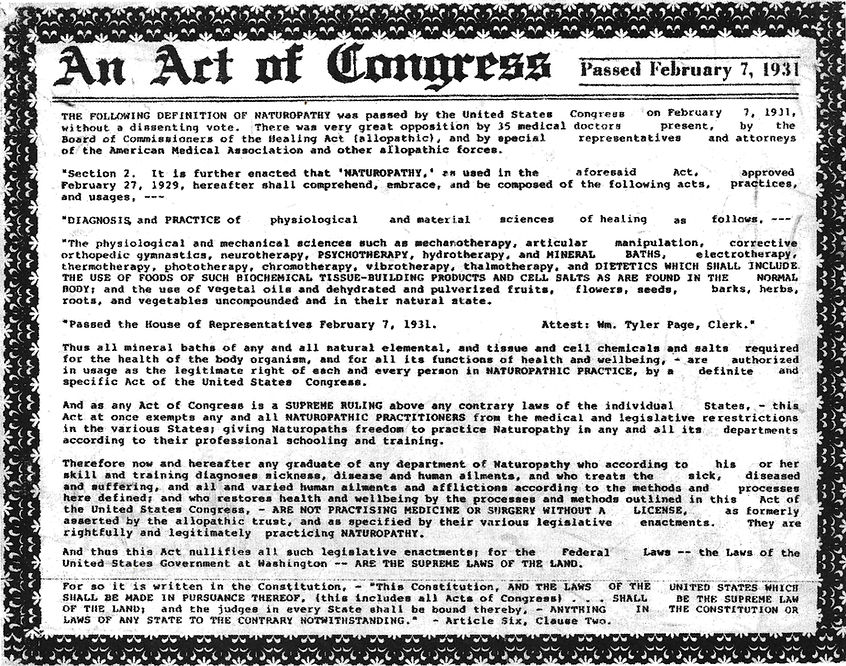
The U. S. House of Representatives discussed naturopathy in the 1929 Act of Congress dated February 27, 1929 and it’s clarifying amendment. This seems to have establish the “congressional intent” that naturopathy is a separate branch of the healing arts and should be on the same level as other forms including medicine, chiropractic, and osteopathic. The Act of Congress dated February 7, 1931 makes that fairly clear. (see Image 1)
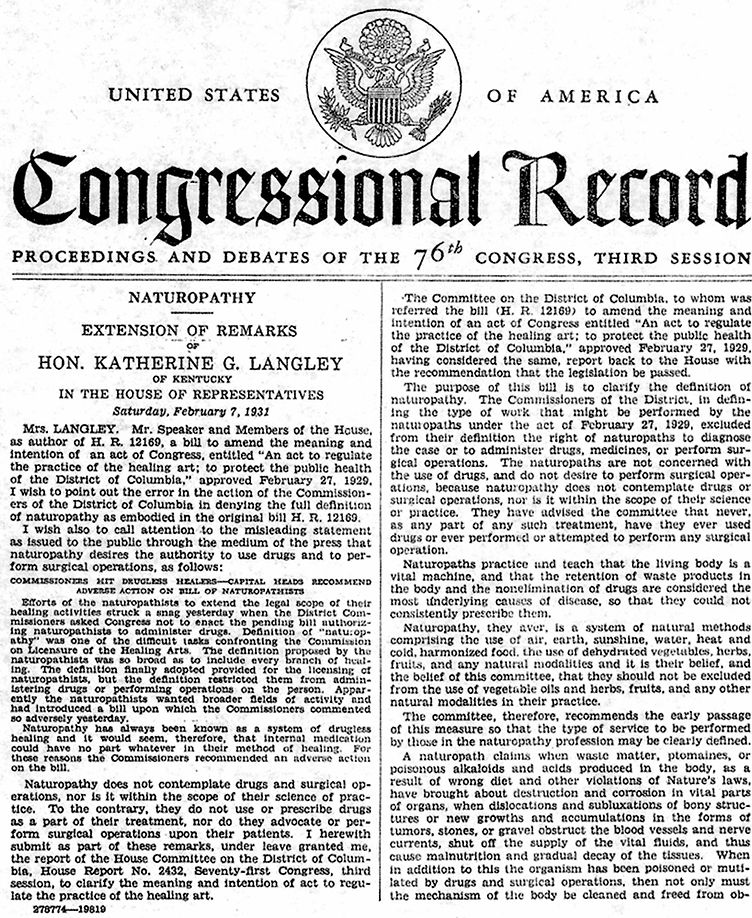
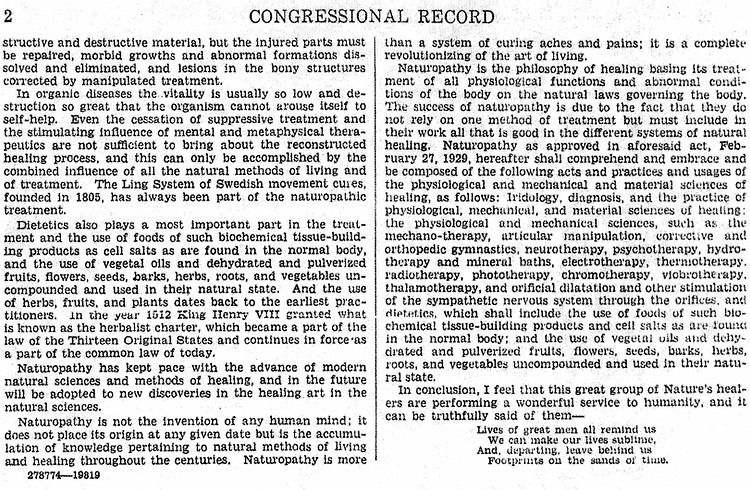
In addition, the Congressional Record also dated February 7, 1931 contained the following comments on naturopathy by Katherine G. Langley who was a Congressional representative from Kentucky. (see Image 2)
What is interesting about Representative Langley’s comments is that even in 1931 there was a debate on whether or not naturopaths should administer medications or perform surgeries. Her conclusions are that essentially by definition, such interventions are not “naturopathic.” Since Dr. Lust purchased rights to the term “naturopathy”, if he actually wanted the field of naturopathy to include the prescribing of drugs or the performance of surgeries, he probably would have had that added to either the Act of Congress or the Congressional Record. Instead, they declare the opposite view, “Naturopathy does not contemplate drugs and surgical operations, nor is it within the scope of the science of their practice” (Congresswomen Langley, 1931)
Thiel, R. J. (2000). Combining Old and New Naturopathy for the 21st Century. Warsaw, IN.: Whitman.
This historical context helps illustrate why naturopathy was recognized as a distinct healing practice. By showing how it was defined in Congress and the Congressional Record, we can see its unique role in the broader field of healthcare
Naturopathy’s journey stretches back to the healing traditions of both Western and Eastern practices, drawing inspiration from the time of Hippocrates and evolving through the centuries. By the late 19th and early 20th centuries, naturopathy began to take root as a distinct field, influenced by the work of pioneer Benedict Lust and other natural healers.
As a philosophy, naturopathy is anchored in the belief that the body has an innate ability to heal itself—known as “vis medicatrix naturae.” Modern naturopathy grew from 19th-century nature cures and spa treatments in Germany, blending those traditions with Ayurveda, traditional Chinese medicine, and other natural systems. By the early 20th century, naturopaths like Dr. Thomas Allinson promoted a natural lifestyle focused on diet, exercise, and avoiding drugs and alcohol—a movement that paralleled the growing interest in holistic medicine.
In the United States, the 1931 Act of Congress began to formally recognize these practices, helping to establish naturopathy as a distinct profession. Since then, naturopathy has evolved to integrate evidence-based approaches and a collaborative spirit with conventional medicine. This rich legacy shows the journey of natural healing from its early roots to its place in modern integrative healthcare.
Imagine a glimmering thread of nature’s wisdom woven through time, connecting healers of the past with the seekers of today. In the heart of naturopathy lies a gentle, magical harmony with the earth—a dance of herbs, elements, and the natural rhythms of life. Each remedy and practice reflects the beauty of ancient traditions, brought forward like a gentle stream flowing into a modern river.